
Why Most Analysts are Blind to the Trend
Most market participants are focused on the wrong inputs. They fixate on price, lagging indicators, and sentiment while missing the underlying pulse that actually governs market movement.
They study space—price action—waiting for perfect confirmation, while ignoring the more decisive dimension.
Time.
This principle is as old as the markets themselves and was most clearly articulated by W.D. Gann. Understanding it is the difference between reacting to moves and being positioned before they occur—and it’s the framework that has defined every major inflection of this cycle.
1. The Speed is the Signal: From Weak to Strong
Most analysts view a “sharp, violent drop” as the beginning of a crash. Gann viewed it as a mechanical necessity.
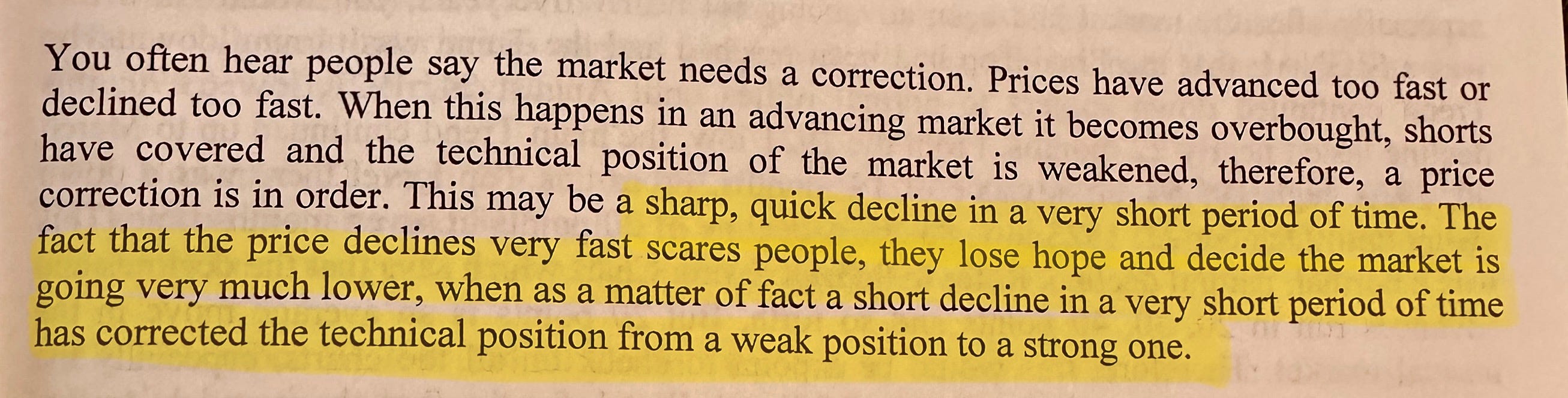
When a market advances too quickly, it creates a “weak technical position.” Leverage is high, and “weak hands” are sitting on unrealized gains they aren’t prepared to lose. A slow, grinding correction allows these participants to linger. But a short, sharp correction does something else: it compresses months of potential downside into a singular, violent window.
“A sharp decline in a very short period of time has corrected the technical position from a weak one to a strong one.” — W.D. Gann
This excerpt from Gann in How to Make Profits in Commodities perfectly describes the current behavior of this market.
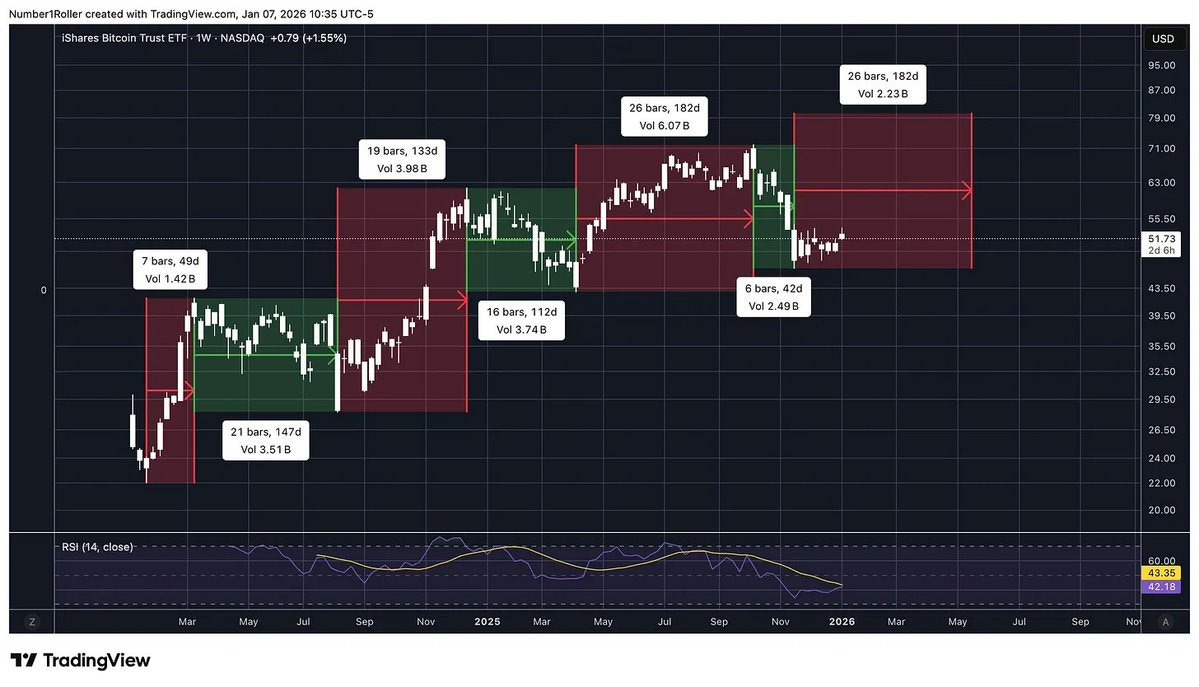
By flushing out the leverage in record time, the market achieves a total structural reset. The “weak position” is liquidated, and supply is transferred to “strong hands.” This isn’t a breakdown; it’s a purification.
2. The Law of Overbalance: Time is the Final Arbiter
This is where 99% of “Four Year Cycle” analysts and strict PA Analysts go wrong. They are watching the halving clock, and price levels, but they aren’t watching the Trend Clock.
Gann was explicit on this point. A trend does not change because of opinion or narrative—it changes when both price and time overbalance.
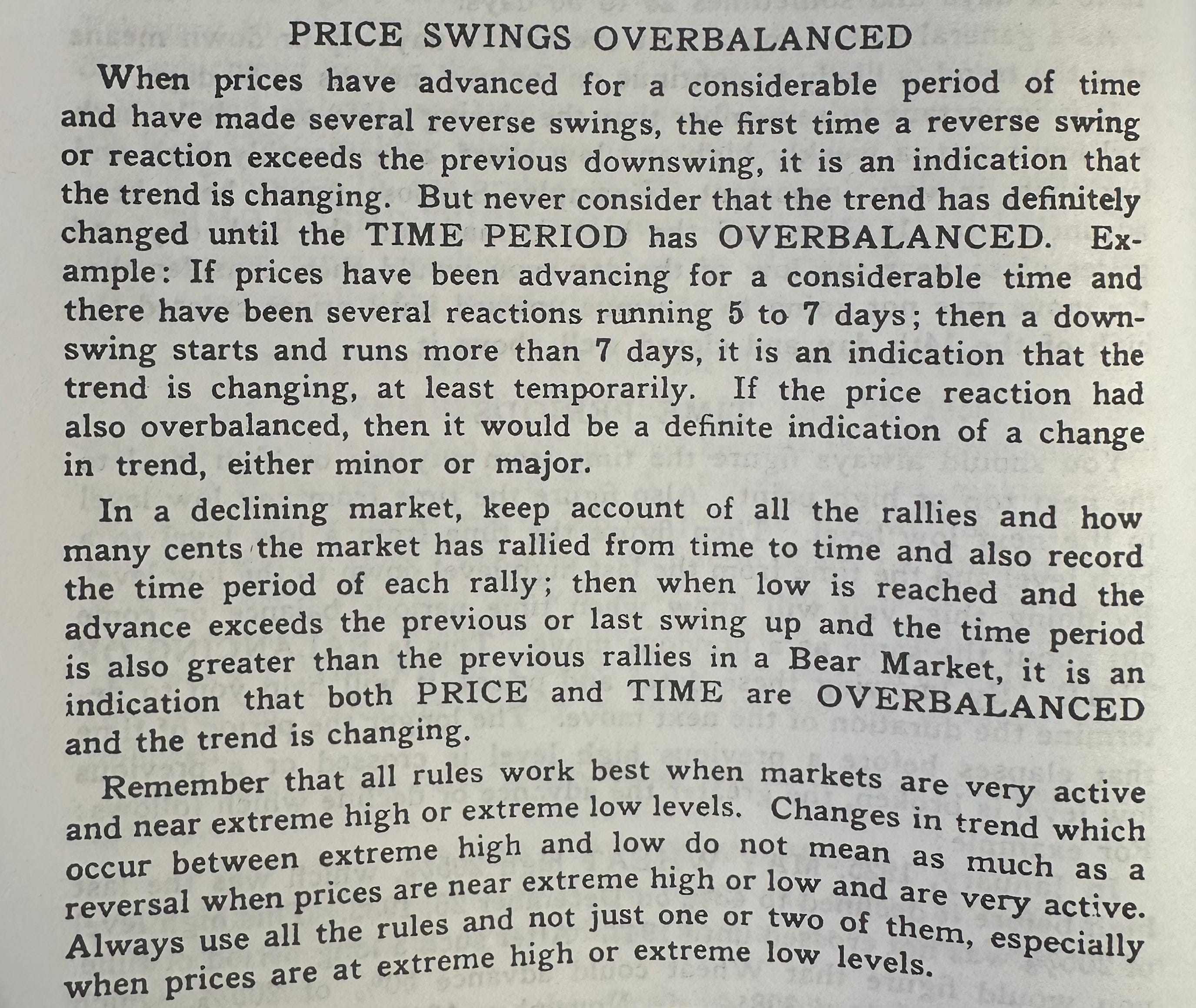
“…then when low is reached and the advance exceeds the previous or last swing up and the time period is also greater than the previous rallies in a Bear Market, it is an indication that both PRICE and TIME are OVERBALANCED and the trend is changing.”
In a true Bull Market, the most important law is this: Price must spend more time moving up than moving down. This is the Law of the Trend.
The math is absolute. If a “recovery” or “relief rally” persists longer in Time than the decline that birthed it, the structural integrity of the bear move is invalidated.
The Reality: We saw a 46-day corrective drop.
The Confirmation: We have now been trending higher for 53+ days and counting.
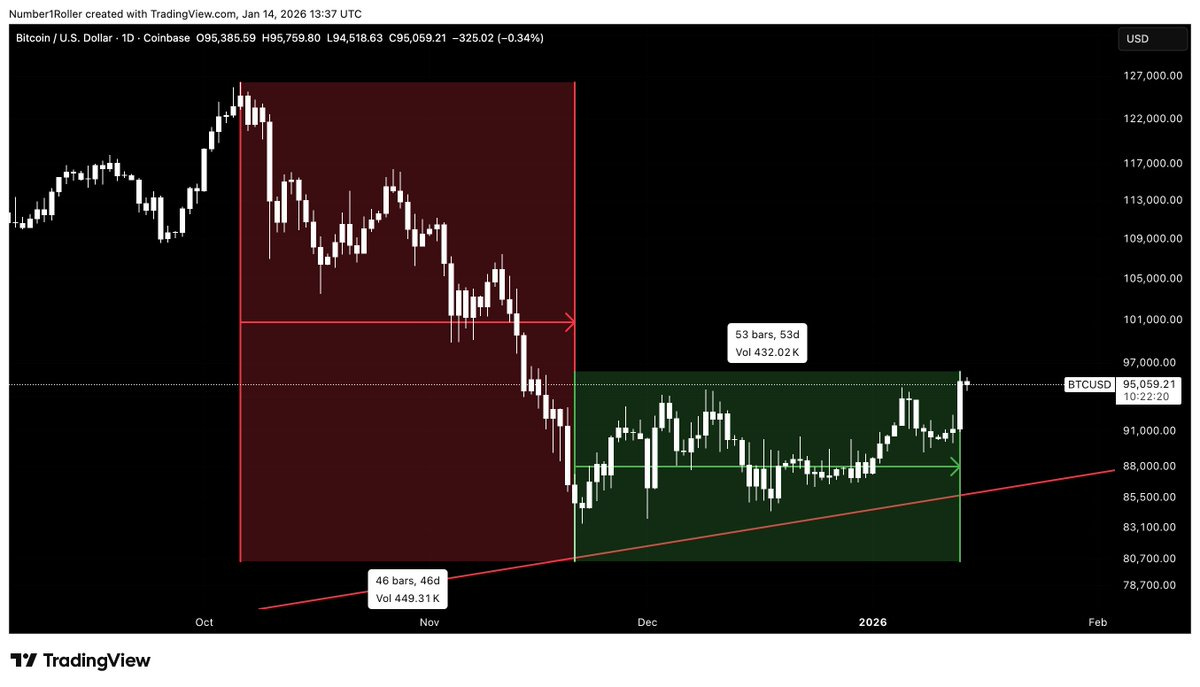
That time overbalance confirms the trend.
This stands in direct contrast to early 2022, when the initial advance failed to exceed the prior decline in time—signaling the start of a bear market.
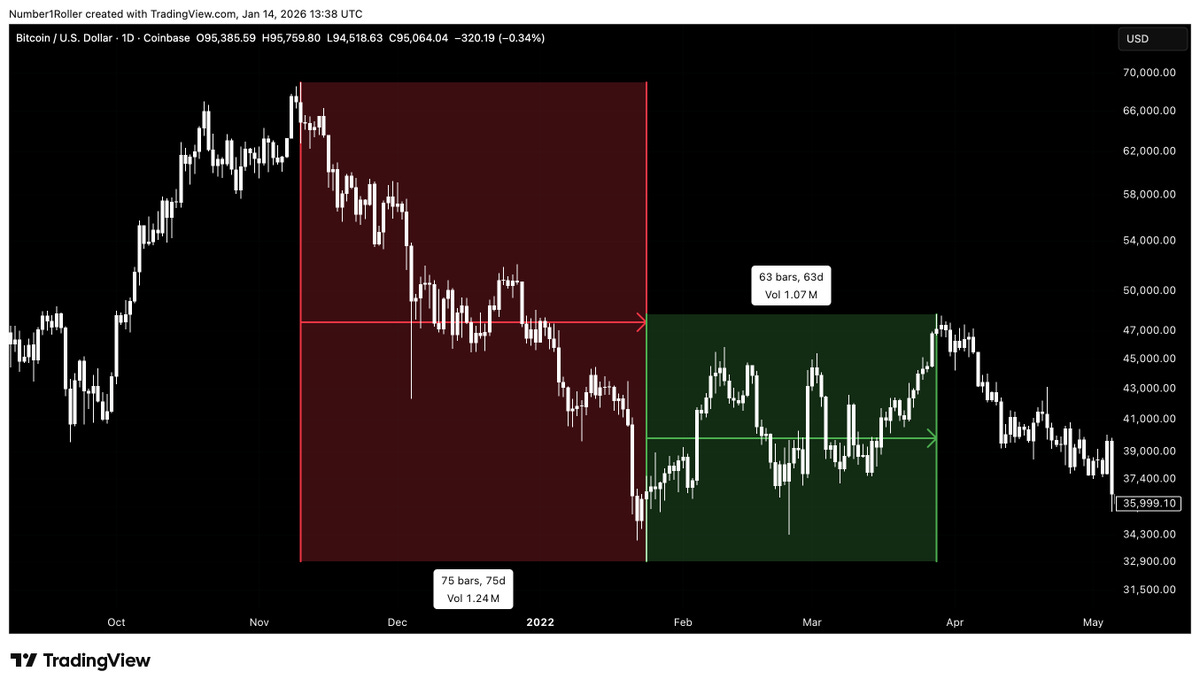
You’ve likely seen the comparisons circulating on X, framing this market as a repeat of the 2022 double top. That analogy has already been invalidated—not by opinion, but by structure.
There is a simple but powerful rule that resolves the debate: there is no instance in Bitcoin’s history where a bear market countertrend rally lasted longer in time than the decline that preceded it.
By overbalancing the correction in time, the market has already delivered its verdict. The macro trend isn’t merely intact—it has reasserted itself with force.
3. The 60-Day Resolution
History of the current cycle shows that major $BTC bottom ranges typically resolve within a rough 60 day window. We are currently at Day 58. The conclusion is inescapable: the “coil” is no longer just winding; it is snapping
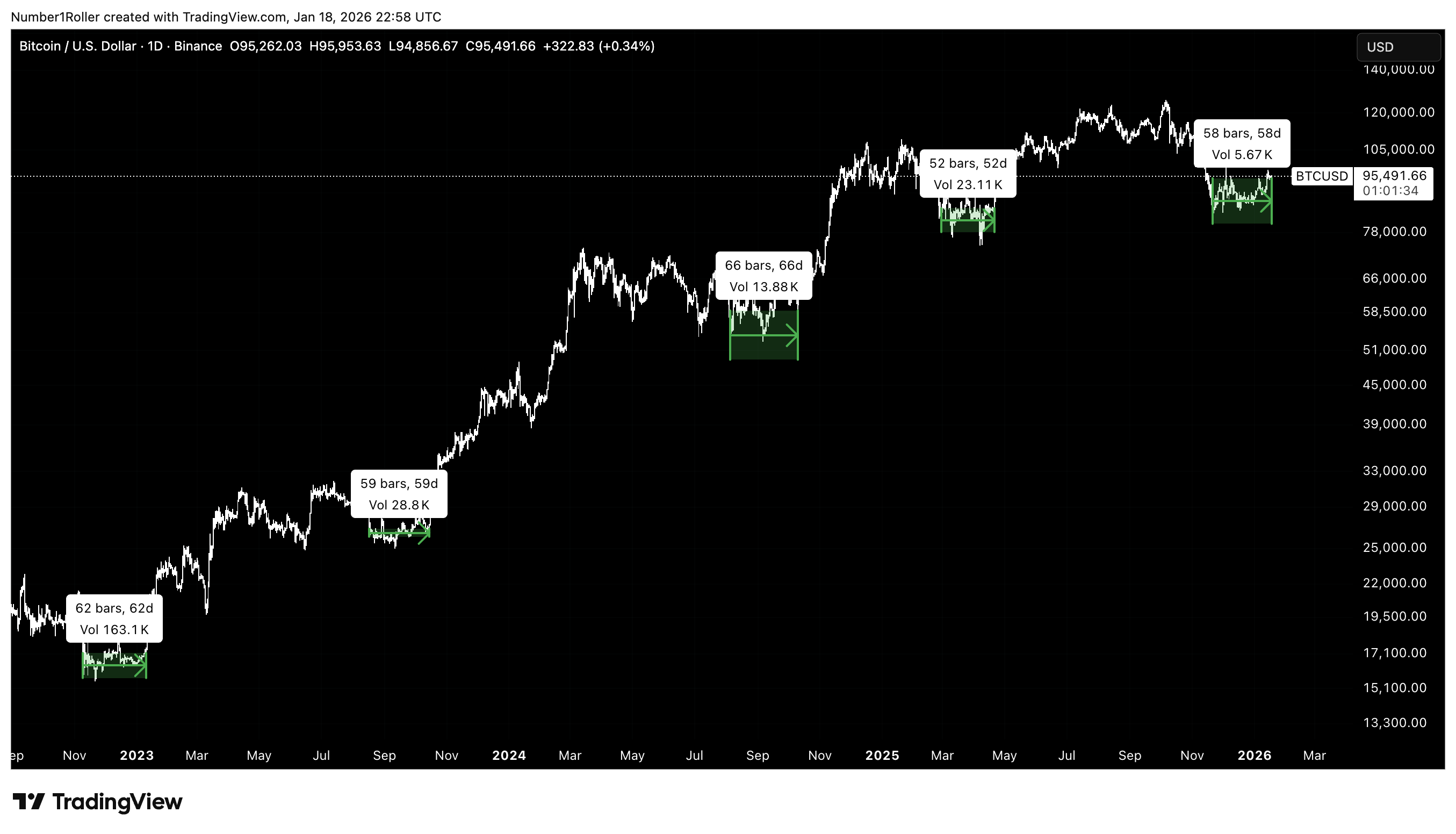
The Verdict: The Tape Is Clear
This is not 2022.
And it is not an end-of-cycle event.
What we’ve witnessed is a structural reset—one that clears leverage, restores balance, and reestablishes trend. Price has done its work and now time is showing us the signal.
While much of the market spent months declaring the structure “broken,” the market was quietly rebuilding, exactly as it has at every major inflection before sustained expansion.
As we move into 2026, that structure is no longer latent—it is asserting itself.
The period of indecision is behind us. Capital is beginning to rotate, leadership is shifting, and the market is transitioning into a phase where execution matters more than commentary.
For those looking to translate this shift into positioning, I’ve outlined the full framework in my latest report:
The 2026 Portfolio Reset: Positioning for the Great Rotation
Inside is a complete breakdown of the Macro Compass and Aggressive Alpha portfolios—a barbell approach designed to balance structural leaders with asymmetric opportunities as the cycle accelerates.
Markets don’t reward consensus.
They reward discipline, structure, and respect for time.